
  |

|
 SHOP NOW |

|
|

|
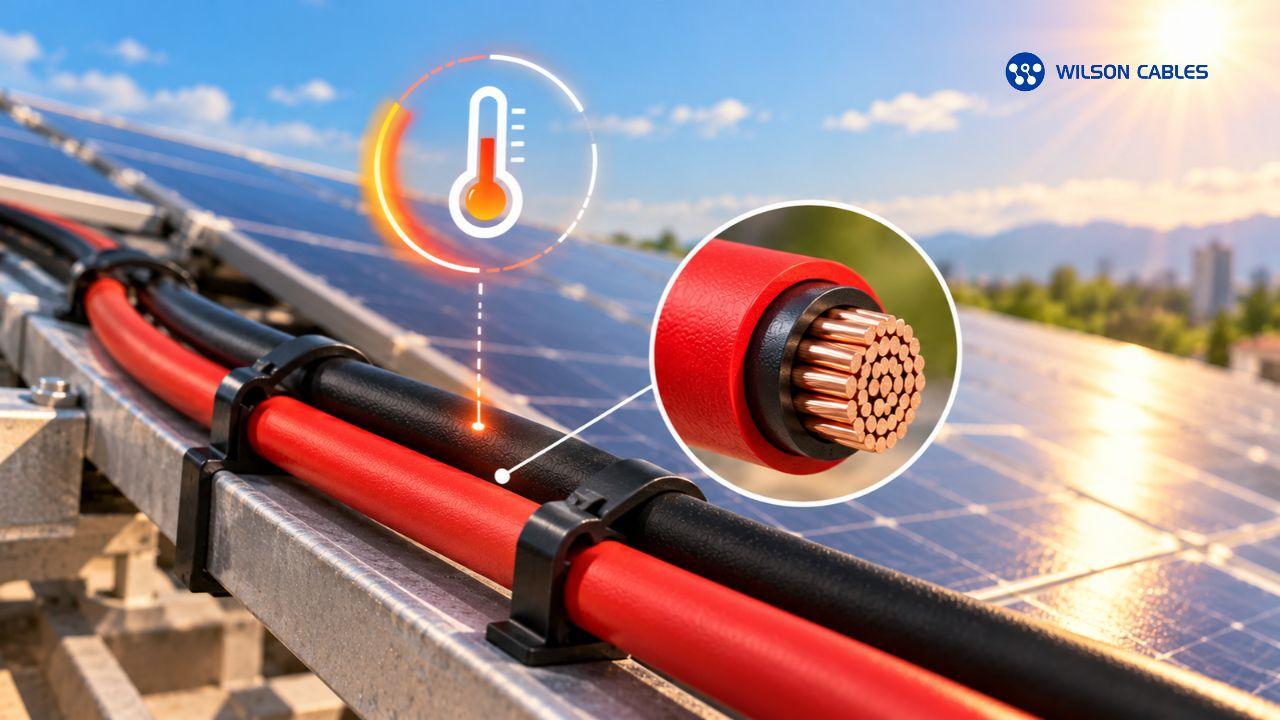
Solar cable works in conditions very different from cable indoors. In a solar power installation, cable can sit in direct sun, run close to a hot roof surface, and carry current for hours at a time. All of that makes heat an important part of the decision.
The temperature rating of a solar cable is the temperature limit or range the manufacturer allows for the cable under stated conditions. The figure always has to be read together with the type of temperature it refers to and how long it applies for. A conductor temperature limit, for example, is not the same thing as an ambient temperature limit.
Understanding those details helps you choose a cable that suits the system and reduces the risk of heat damage. Here is a plain explanation of the types of temperature rating, what the numbers on a datasheet mean, and how to choose.
A temperature rating shows how well a cable can operate under certain thermal conditions. That capability comes from the insulation and sheath materials and from the construction of the cable itself.
When a conductor carries current, it produces heat. The insulation has to keep doing its job at the permitted temperature throughout its service life. Exposure to temperatures that are too high can speed up the breakdown of the material.
A temperature rating should always be checked alongside the voltage rating and the current carrying capacity. A cable that handles high temperatures is not automatically right for the voltage of your system or the current it has to carry. The three parameters answer three different questions.
A datasheet can list several temperature limits at once. To read them correctly, it helps to know what each one means.
Ambient temperature is the temperature around the cable, for example the air along the installation route. It affects how well the cable can release heat.
Ambient temperature is not the same as conductor temperature. A cable carrying current can have a conductor temperature higher than the air around it.
This figure is the temperature limit for the conductor while the cable is in service. For continuous use, look for a line such as maximum continuous conductor temperature.
That limit is a thermal design reference, not a temperature the cable is supposed to reach in use. Current and installation conditions should be arranged so that the limit is not exceeded.
Some products allow a higher conductor temperature for a limited amount of time. That allowance has to be read in full. It should never be taken as permission to run at that temperature indefinitely.
Check whether the stated duration is a cumulative total of operating hours, and what other conditions the manufacturer attaches to it.
During a short circuit, fault current can raise the temperature very quickly. For that reason, some datasheets list a conductor temperature limit that applies for a very short duration.
Where it is stated, the minimum installation temperature is the limit below which the cable should not be installed or bent under normal procedure. That figure can differ from the minimum temperature allowed once the cable is already in place.
The difference comes down to how the material behaves under mechanical force. Do not assume that the operating temperature range automatically applies to every installation activity.
The figures 90 C and 120 C appear often on PV cable specifications. What they mean, though, depends on the wording of that particular product.
On some solar cable specifications, the maximum conductor temperature for normal continuous operation is 90 C. Operation at a maximum conductor temperature of 120 C is permitted for up to 20,000 hours, subject to the stated conditions.
In other words, 120 C should not be treated as a reference for unlimited continuous operation. That limited duration is also not a guaranteed extension of service life for every installation.
Here is how to tell the parameters apart:
|
Parameter |
Example wording |
How to read it |
|
Continuous conductor temperature |
Maximum 90 C |
The conductor temperature limit for continuous operation under the stated specification. |
|
Limited duration conductor temperature |
Maximum 120 C for up to 20,000 hours |
There is a time limit and a set of conditions attached. |
|
Short circuit temperature |
Maximum 250 C for five seconds |
A momentary limit that applies during a fault. |
|
Ambient temperature |
Range as stated on the datasheet |
Applies to the conditions around the cable. |
These figures are an example of one product specification, not a universal rule for every solar cable. Always check the datasheet for the cable type you intend to use.
Cable outdoors picks up heat from both the surrounding air and solar radiation. A route close to a hot roof surface can face thermal conditions well beyond the air temperature given in a weather forecast.
Cable selection therefore has to account for conditions at the actual site, including direct exposure and how easily heat can escape.
Heat from current follows a simple principle: as current rises, the heat produced rises with it. At the same resistance, more current means more heat.
For the same material and length, a smaller conductor cross section has higher resistance. Even so, cable sizing still has to consider current carrying capacity, voltage drop, and the installation conditions together.
Cable in free air sheds heat differently from cable inside a conduit or any route that restricts airflow. Grouping several loaded cables together also raises the temperature of all of them.
That is why the current carrying capacity figure has to match the installation method. A value taken from one condition cannot be applied directly to another.
A joint with high resistance can create local heat even when the cable size is correct. An incorrect crimp or a faulty connector contact should be part of any installation review.
Choosing a cable with a higher temperature rating does not fix a problem at the joint. MC4 connectors and terminals still need matched components and correct assembly.
Running a cable outside its temperature conditions can accelerate ageing in the insulation and sheath. As the material declines, it can lose both its electrical and its mechanical protection.
The consequences can include cable damage, insulation faults, shutdowns, and replacement costs. The situation can also increase the risk of electrical faults.
Service life cannot be judged from a single temperature rating figure. Heat exposure, load, environmental conditions, installation quality, and maintenance all play a part.
Start from what the installation needs, then match that against the product specification.
For a wider look at cable selection, read our guide on how to choose the right solar panel cable.
A solar cable temperature rating has to be read in terms of the type of temperature, the duration it applies for, and the conditions of the installation. A maximum figure on its own is not enough to decide whether a cable suits a solar power system.
A sound choice brings together the temperature rating, the current carrying capacity, the conductor size, the voltage, and the compatibility of the components. Contact Wilson Cables to discuss the requirements and cable specifications for your solar project.
Can a solar cable rated 120 C be used at that temperature continuously?
Not automatically. On some products, 120 C is a conductor temperature limit with a restricted duration. Follow the wording for continuous operation and all the conditions set out on the datasheet.
Is conductor temperature the same as ambient temperature?
No. Ambient temperature describes the conditions around the cable, while conductor temperature is the temperature of the conductor itself. Current flow can make the conductor hotter than its surroundings.
Is a cable with a higher temperature rating always the better choice?
No. Suitability also depends on voltage, current, installation method, site conditions, and the components connected to it. Choose based on the needs of the system as a whole.
Does a high temperature rating mean the cable is fire resistant?
No. A temperature rating relates to thermal conditions in normal use. Slowing the spread of flame, or keeping a cable working during a fire, calls for separate specifications and separate testing.
Does cable size still need to increase if the temperature rating is high?
It can do. If the corrected current carrying capacity is not sufficient, or the voltage drop is too large, the cable size needs to be reviewed. A high temperature rating does not replace cable sizing calculations.
|
Wilson Cables is a trusted electrical cable brand produced by PT. Willson Surya Unggul, a cable manufacture company in Tangerang, Indonesia, which has been established since 1989. Since the beginning, we have been fully committed to producing high quality cables with a choice of products from building cables, automotive cables, audio cables, electronic cables, to cables for use. special.
|
Our Location
Jl. Veteran No.9A, Kadu Jaya, Kec. Curug, Tangerang, Banten 15810
 021-5986868 / 0856-8686868
|
Sitemap
|
Download Our Product Catalog
Download |

|


