
  |

|
 SHOP NOW |

|
|

|
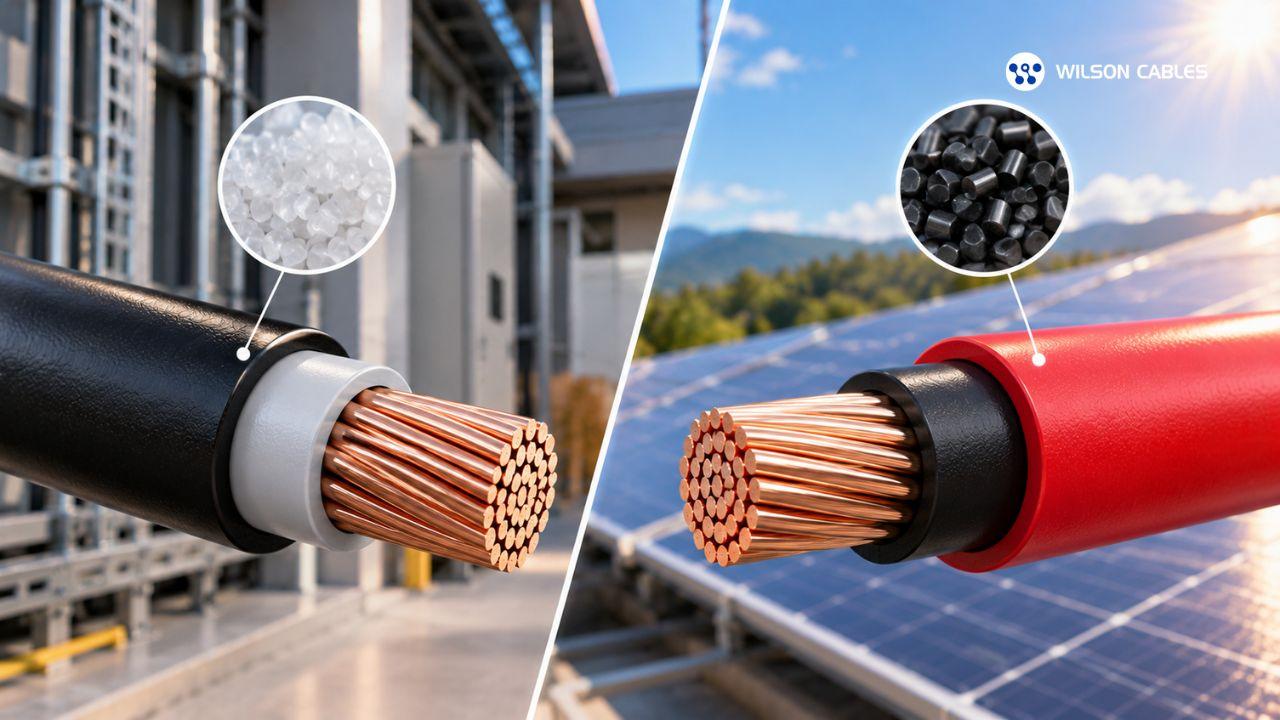
When people choose cable for a solar panel system, they usually think about cable size, current capacity, and how far the cable has to run. One thing often gets overlooked: the material wrapped around the copper.
Two names show up again and again on cable spec sheets: XLPE (Cross-linked Polyethylene) and XLPO (Cross-linked Polyolefin). They sound almost the same, and both use a process called cross-linking to make the material stronger. But they have different properties and are built for different jobs.
So what is the real difference between XLPO and XLPE? And why does most modern solar cable use XLPO? Here is the full explanation in plain language.
XLPE stands for Cross-linked Polyethylene. It is a cable insulation material made by cross-linking polyethylene. Cross-linking locks the molecules together into a stronger structure, so the material handles heat, mechanical pressure, and chemicals better than ordinary polyethylene.
Because it performs well, XLPE is used in many kinds of power cable, from low voltage up to medium voltage. On cable codes, XLPE insulation is usually marked as 2X. You will see it in cable types such as N2XY and N2XY-FRC.
What XLPE does well:
XLPE has been a first choice for power distribution for many years, because it delivers stable performance across a wide range of conditions.
XLPO stands for Cross-linked Polyolefin. It comes from the polyolefin family and goes through cross-linking as well. The difference is what it was developed for: outdoor conditions, and solar systems in particular.
In solar cable, XLPO is used for both the insulation and the outer sheath. It is built to survive years of ultraviolet (UV) light from the sun, extreme temperatures, moisture, and changing weather.
XLPO is also the material behind most solar cable that meets H1Z2Z2-K, the international standard for photovoltaic (PV) cable.
What XLPO does well:
Those strengths are the reason XLPO has become the common choice for modern solar cable.
Both materials are cross-linked, but each one is tuned for a different purpose.
|
Property |
XLPE |
XLPO |
|
Material name |
Cross-linked Polyethylene |
Cross-linked Polyolefin |
|
UV resistance |
Good |
Very good |
|
Temperature resistance |
High |
Very good |
|
Flexibility |
Good |
More flexible |
|
Flame retardant |
Depends on the formulation |
Generally better |
|
Low Smoke Zero Halogen (LSZH) |
Not always available |
Generally available |
|
Outdoor use |
Good |
Very good |
|
Main application |
Power cable |
Solar cable (PV cable) |
The table shows that both materials are high quality. XLPO simply adds the extra properties that outdoor solar installations need.
Solar cable works in harder conditions than cable inside a building. Here is what it faces, and how XLPO answers each challenge.
Solar panels sit out in the open, so the cable is exposed to sunlight every day for years. XLPO has very good resistance to ultraviolet radiation, which helps the insulation stay in good condition over the long term.
A rooftop can get very hot during the day and cool down sharply at night. XLPO is designed to stay stable through those swings, so the cable keeps performing as it should.
A flexible cable is easier to route along the installation path. That matters on rooftop solar, where the run usually has many bends and changes of direction.
Most modern solar cable built to the H1Z2Z2-K standard uses XLPO, because the material meets the technical requirements of photovoltaic systems.
XLPO can be formulated as flame retardant and Low Smoke Zero Halogen (LSZH). That combination helps slow the spread of fire while also reducing the smoke and toxic gas released during a fire.
Absolutely. XLPE is still an excellent insulation material and is used widely across electrical applications.
You will commonly find it in:
With strong electrical and mechanical properties, XLPE remains the right choice when it is used for the application it was designed for.
For solar panel systems, however, XLPO is usually preferred, because it was developed specifically for photovoltaic installations that live outdoors.
Wilson Cables offers H1Z2Z2-K Solar Cable, designed specifically to support solar panel installations.
The cable uses Cross-linked Polyolefin (XLPO) insulation, which resists UV light, extreme temperatures, and a wide range of outdoor conditions. It is also flame retardant and Low Smoke Zero Halogen (LSZH), with double insulation construction for added protection in a solar power system.
Wilson H1Z2Z2-K Solar Cable is available in 4 mm² and 6 mm², so it can be matched to different types of solar panel installations.
Want the full specifications? Explore the Wilson H1Z2Z2-K Solar Cable range to help you choose the right cable for your solar project.
XLPE and XLPO are both high performance cable insulation materials, but they were developed for different applications.
XLPE is widely used in power cable because of its strong electrical and mechanical properties. XLPO adds UV resistance, tolerance for extreme temperatures, and flame retardant and Low Smoke Zero Halogen behaviour, which makes it a better fit for solar panel applications.
So if you are choosing cable for a solar power system, solar cable with XLPO material is the more suitable option. It is built to support the safety, efficiency, and service life of the installation.
What is XLPO?
XLPO (Cross-linked Polyolefin) is a cable insulation material designed for outdoor use, including solar panel systems, because it resists UV light, extreme temperatures, and moisture.
What is XLPE?
XLPE (Cross-linked Polyethylene) is a cable insulation material widely used in power cable because of its good electrical, mechanical, and thermal properties.
What is the difference between XLPO and XLPE?
The main difference is the application each one is built for. XLPO is optimised for solar cable with better UV and weather resistance, while XLPE is more common in power distribution cable.
Which one is better for solar cable?
For solar panel applications, XLPO is generally the better choice. It is designed for outdoor conditions and meets the requirements of photovoltaic cable standards.
Does every solar cable use XLPO?
Not every one. But most modern solar cable built to international standards such as H1Z2Z2-K uses XLPO, because its performance suits solar power systems.
Is XLPE resistant to UV light?
XLPE holds up well in many environments. For solar panel applications with constant sun exposure, however, XLPO generally provides better long term protection.
|
Wilson Cables is a trusted electrical cable brand produced by PT. Willson Surya Unggul, a cable manufacture company in Tangerang, Indonesia, which has been established since 1989. Since the beginning, we have been fully committed to producing high quality cables with a choice of products from building cables, automotive cables, audio cables, electronic cables, to cables for use. special.
|
Our Location
Jl. Veteran No.9A, Kadu Jaya, Kec. Curug, Tangerang, Banten 15810
 021-5986868 / 0856-8686868
|
Sitemap
|
Download Our Product Catalog
Download |

|


