
  |

|
 SHOP NOW |

|
|

|
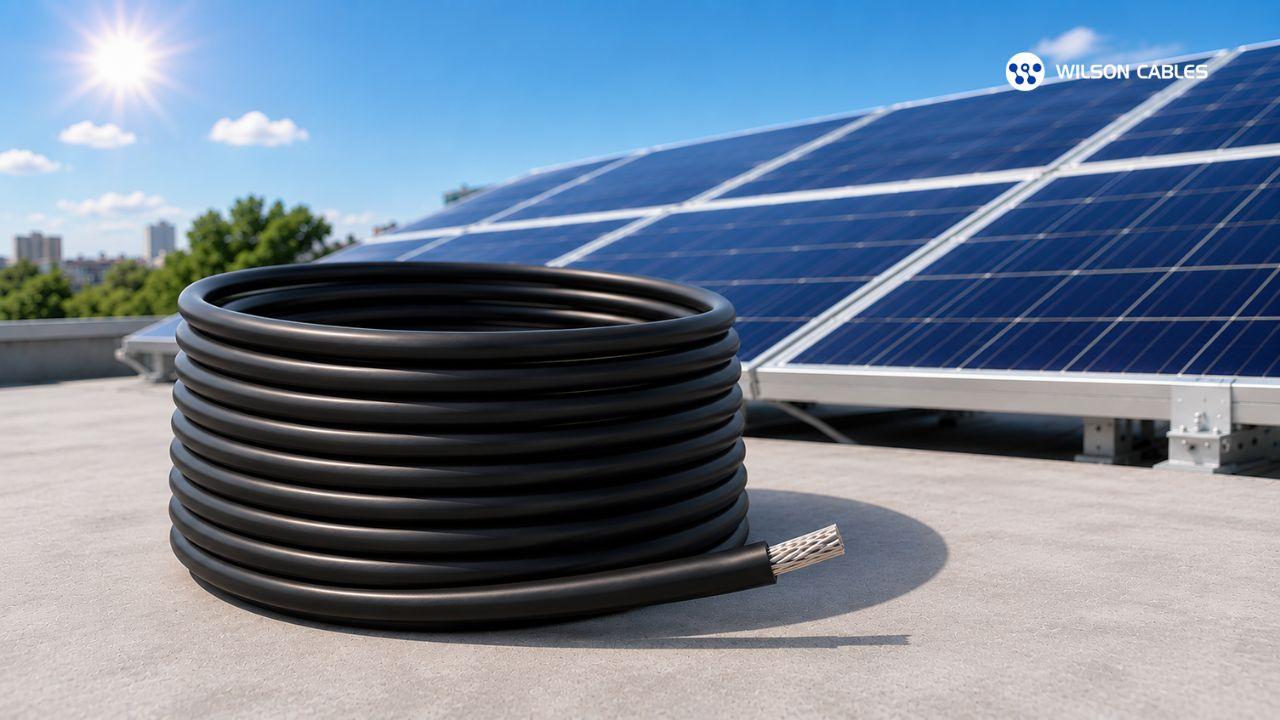
As solar photovoltaic (PV) systems become more common in homes, commercial buildings, and industrial sites, the quality of supporting components becomes increasingly important. Besides solar panels and inverters, one vital component that often receives too little attention is the solar cable.
Solar cable is the main electrical path that carries power from the solar panels to the inverter and other equipment. A cable with the wrong specification can reduce system efficiency, damage the installation, and increase electrical safety risks.
So, what is solar cable, and how is it different from ordinary building wire? This guide explains its purpose, key characteristics, and the main points to consider when choosing a cable for a solar PV installation.
Solar cable, also called PV cable or photovoltaic cable, is designed specifically for solar PV systems. It carries the direct current (DC) produced by solar panels to the inverter, combiner box, charge controller, or other equipment in the system.
Unlike conventional building wire, solar cable is designed to work outdoors for long periods. Because many solar panels are installed on roofs or in open areas, the cable must withstand sunlight, major temperature changes, moisture, and rain.
Using solar cable that meets the required standards is therefore important for the safety, efficiency, and service life of a solar PV system.
Solar cable may look simple, but it performs several important functions in a PV installation.
The main job of solar cable is to carry DC power from the solar panels to the inverter or other equipment. The connection must remain stable so that the electricity generated by the panels can be used effectively.
The correct cable size and route help limit voltage drop while electricity is being transmitted. Lower voltage drop means less power is lost and the overall PV system can operate more efficiently.
Solar cable is built to reduce the risk of damage caused by heat, moisture, and other environmental conditions. This helps the system operate safely over the long term.
Solar PV systems are normally expected to operate for decades. A good-quality solar cable helps the installation last longer and reduces the need for early cable replacement.
Solar cable has several characteristics that distinguish it from ordinary building wire.
Most solar installations are outdoors, where the cable is exposed to sunlight every day. Solar cable therefore uses insulation and sheathing materials that resist ultraviolet (UV) radiation and are less likely to crack or degrade.
Solar cable is designed to work across a wide range of low and high temperatures. This makes it suitable for different climates and exposed installation areas.
Solar cable commonly uses an insulation layer plus an outer sheath, giving additional protection against current leakage and mechanical damage. Unlike ordinary building wire such as NYAF, which normally has a single PVC insulation layer, solar cable uses cross-linked polyolefin (XLPO) materials. XLPO offers important benefits such as UV resistance, flame retardance, and low-smoke zero-halogen (LSZH) performance.
The material used in solar cable can also be flame retardant, which helps slow the spread of fire if an electrical fault occurs.
Many modern solar cables use low-smoke zero-halogen (LSZH) materials. When exposed to fire, these materials produce less smoke and do not release halogen gases, improving safety during an emergency.
Because solar cable is often installed in exposed areas, it must be rated to withstand rain, condensation, and high humidity without losing performance.
Solar cable is flexible enough to follow the required cable route while still maintaining its mechanical strength. This makes installation easier, especially around panel arrays and cable trays.
Although both carry electricity, solar cable has different specifications from the wires normally used in building installations.
|
Item |
Solar Cable |
Ordinary Building Wire (NYAF) |
|
Typical circuit |
DC solar PV circuit |
Low-voltage building circuit, commonly AC |
|
Installation location |
Outdoor and indoor |
Mainly indoor |
|
UV resistance |
Yes |
No, unless specifically rated |
|
Temperature resistance |
High |
More limited; depends on the product rating |
|
Conductor |
Tinned copper |
Copper (Cu) |
|
Protective layers |
Insulation plus outer sheath |
Single insulation layer |
|
Insulation / sheath material |
Cross-linked polyolefin (XLPO) |
Polyvinyl chloride (PVC) |
|
Weather resistance |
Excellent; designed for UV and outdoor exposure |
Not intended for long-term exposed outdoor use |
|
Main application |
Solar PV systems |
Building electrical installations |
The table above shows that solar cable is purpose-built for PV systems. Using ordinary building wire on exposed DC solar circuits can reduce safety and service life because the wire may not be designed for long-term UV exposure, outdoor weather, or the operating conditions of a PV system.
Solar cable is used in many types of PV installations, from residential systems to large industrial projects.
In a home solar installation, solar cable connects the panels to the inverter so the generated electricity can be used by the household.
Offices, shopping centres, warehouses, and factories use solar cable to provide stable power connections in larger-capacity PV systems.
In a ground-mounted solar power plant, solar cable connects panel strings to the power collection system and inverter.
Solar cable is also widely used in off-grid systems in remote areas, farms, fishponds, and other locations that are not connected to the main electricity grid.

Some people assume that ordinary building wire can be used in a solar PV system. However, a cable that is not designed for the application can create several risks.
Ordinary building wire is generally not recommended for exposed solar PV circuits because it may:
For these reasons, using standards-compliant solar cable is an important investment in the safety and performance of the PV system.
The cable should be selected according to the electrical design and installation conditions so the system can operate safely and efficiently.
Important points to check include:
For a more detailed explanation of cable type and size selection, read Wilson Cables' guide, How to Choose the Right Solar Cable.

Wilson Cables offers H1Z2Z2-K Solar Cable for a wide range of PV installations, from residential rooftop systems to commercial and industrial projects.
This cable is designed for outdoor use and offers resistance to UV radiation, extreme temperatures, and moisture. Its insulation-and-sheath construction provides additional protection. It also uses flame-retardant and low-smoke zero-halogen (LSZH) materials for improved safety in an emergency.
Wilson H1Z2Z2-K Solar Cable is available in 4 mm² and 6 mm² sizes to suit different PV system designs.
Need the full technical specifications? Learn more about Wilson H1Z2Z2-K Solar Cable to help you select the right cable for your solar PV project.
Solar cable is an essential part of a PV system. It carries DC power from the solar panels to the inverter and other equipment. Compared with ordinary building wire such as NYAF, solar cable offers important features such as UV resistance, a wider operating-temperature range, double-layer protection, and materials designed for long-term outdoor use.
Choosing the correct solar cable helps reduce power loss while improving the safety and service life of the entire system. Always use a cable that meets the relevant standards and matches the electrical and environmental requirements of the installation.
Solar cable is a purpose-designed cable that carries DC power from solar panels to an inverter or other equipment. It is made to withstand UV radiation, temperature extremes, and outdoor conditions.
Its main purpose is to carry electricity from solar panels safely and efficiently while protecting the circuit against environmental and electrical risks.
No. Solar cable has a construction and rating intended for PV applications, while ordinary building wire is generally used for electrical installations inside buildings.
Most solar installations are outdoors and exposed to sunlight every day. UV resistance helps prevent the insulation and sheath from cracking or degrading prematurely.
A good-quality solar cable that is correctly selected and installed is designed to support long-term PV operation. Its actual service life depends on the cable rating, installation quality, operating conditions, and maintenance.
Choose the cable according to the design current, conductor size, route length, installation environment, system voltage, and applicable PV standards.
|
Wilson Cables is a trusted electrical cable brand produced by PT. Willson Surya Unggul, a cable manufacture company in Tangerang, Indonesia, which has been established since 1989. Since the beginning, we have been fully committed to producing high quality cables with a choice of products from building cables, automotive cables, audio cables, electronic cables, to cables for use. special.
|
Our Location
Jl. Veteran No.9A, Kadu Jaya, Kec. Curug, Tangerang, Banten 15810
 021-5986868 / 0856-8686868
|
Sitemap
|
Download Our Product Catalog
Download |

|


