
  |

|
 SHOP NOW SHOP NOW |

|
|

|
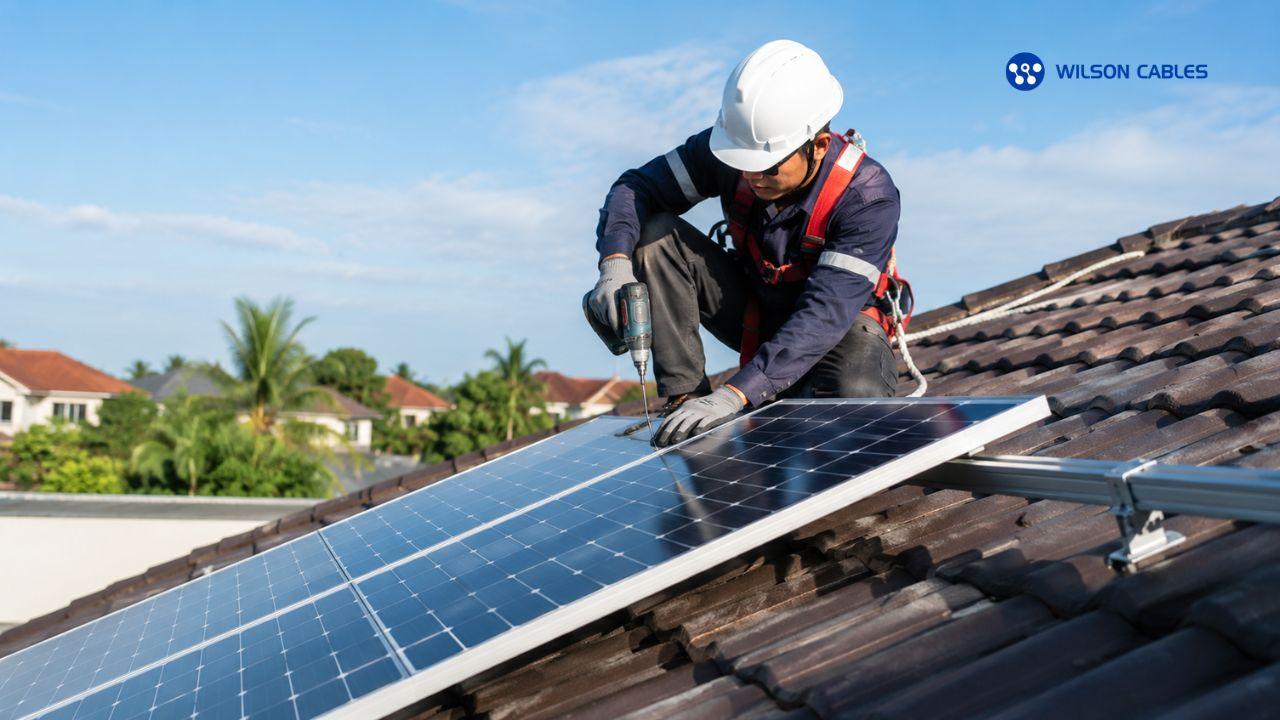
The growth of rooftop solar power plant (PLTS) installations in both Indonesian households and industries continues to rise, driven by net-metering incentives and increased awareness of clean energy. However, one critical component that is often overlooked—even though it determines the safety and lifespan of the entire system—is solar cable (PV cable).
Many installers—and even homeowners who install solar panels themselves (DIY)—still use standard household electrical cables because they assume they’re “the same.” In reality, solar cables have significantly different standards and construction. This article thoroughly covers the types of solar cables, the differences between 4mm² and 6mm² sizes, their applications, and tips for proper installation.
Solar cables commonly used worldwide—including the H1Z2Z2-K type—are specifically designed for Direct Current (DC) applications from solar panels to inverters. Unlike residential wiring cables such as NYA or NYM, which are designed for indoor alternating current (AC), solar cables must be able to withstand extreme conditions:
Wilson Cables currently offers the H1Z2Z2-K in two cross-sectional sizes: 4mm² and 6mm². The difference in size is not just a matter of price; it determines the current-carrying capacity and how far the cable can be run without losing power efficiency (voltage drop).
| Aspects | 4mm² | 6mm² |
| Current capacity | Suitable for small- to medium-scale installations | Higher, suitable for higher currents |
| Ideal run distance | Short- to medium-length runs (standard residential rooftops) | Longer runs or larger string configurations |
| Common applications | Residential rooftops with 1–4 panels | Commercial rooftop, ground-mounted, industrial |
| Voltage Drop | More vulnerable when cable runs are long | More stable over long distances |
Basic principle: the greater the distance between the panels and the inverter, the greater the potential for voltage drop—and the stronger the case for upgrading to 6mm² cable, even if the current being carried remains the same.
The most common installation in Indonesia—a limited number of solar panels on a residential roof (typically 4–12 panels). 4mm² cable is usually sufficient for standard runs under 15 meters, provided calculations are based on the project’s actual current and voltage drop.
Factories, warehouses, or commercial buildings with large arrays of panels require longer cable runs and higher current per string. This is where 6mm² is more often the standard choice to maintain system efficiency.
Ground-mounted installations (not on rooftops) often have longer cable runs from the panels to the inverter/control room, so selecting the correct cable size is crucial to avoid power losses.
Mini solar power systems for remote areas, fish farms, or village electricity generally require long cable runs, given that the distances between installation points are not always ideal—these conditions also generally benefit more from the use of 6mm² cable.
Before purchasing, consider these three factors:
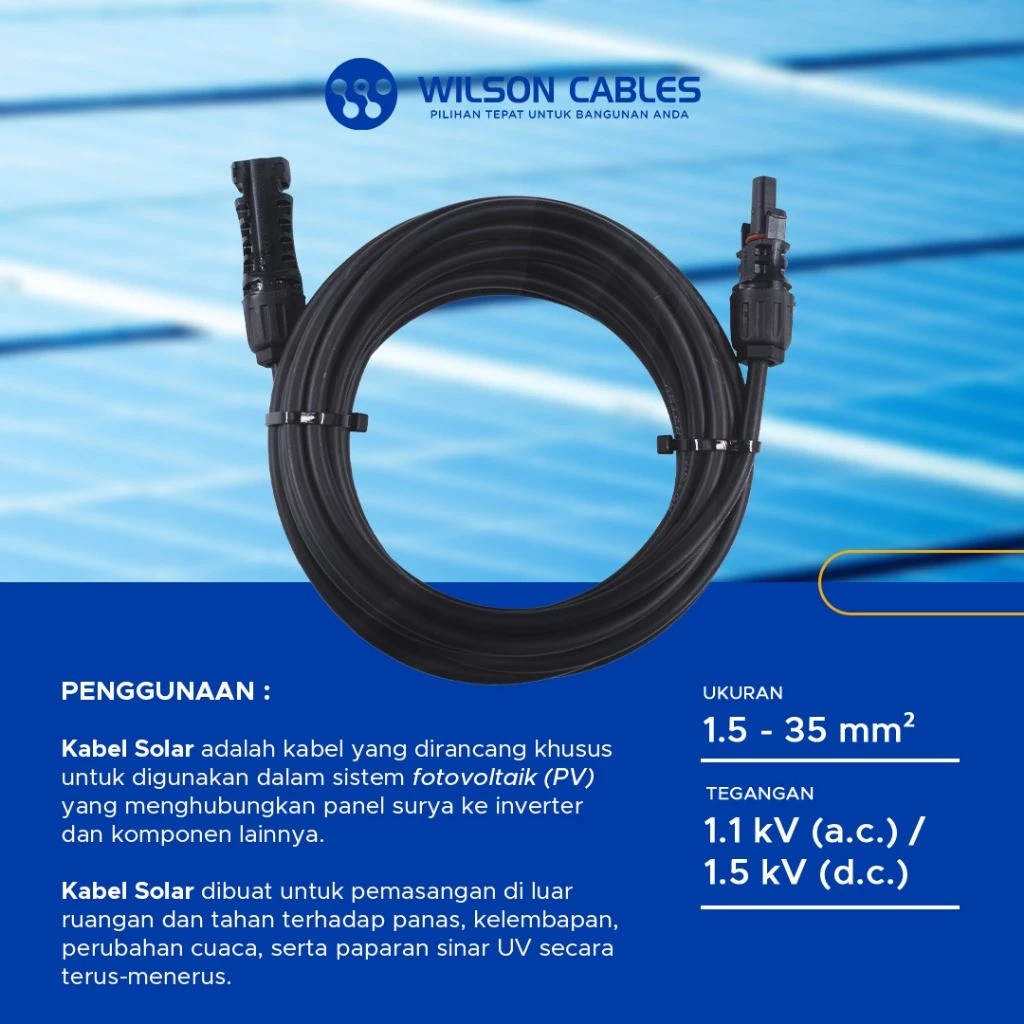
Wilson Cables offers the H1Z2Z2-K in two sizes, 4mm² and 6mm², with construction standards compliant with IEC (International Electrotechnical Commission) and BS (British Standard) — ensuring your cables not only conduct electricity but also safeguard your home and solar power system in the long term.
Buy SOLAR CONNECTOR 1x4 mm² and SOLAR CONNECTOR 1x6 mm² cables on the official Wilson Cables marketplace.
Can solar cable be replaced with standard NYA/NYM cable?
This is not recommended. Solar cable is designed for DC (direct current) power, long-term outdoor exposure, UV rays, and extreme temperature fluctuations, while NYA/NYM cable is designed for indoor AC (alternating current) electrical installations.
When should you use 6mm² solar cable instead of 4mm²?
When the cable run is quite long (generally over 15 meters) or the system carries a higher current, in which case the 6mm² size helps maintain efficiency and reduce voltage drop.
What is the expected lifespan of a good solar cable?
High-quality solar cables with construction that meets IEC standards are generally designed to support the long operational life of a solar panel system, provided the installation follows proper procedures.
Need help determining the right solar cable size for your project? Ask MinWilson directly, or check the availability of Wilson Cables’ H1Z2Z2-K 4mm² and 6mm² solar cables at the official Tokopedia and Shopee stores.
|
Wilson Cables is a trusted electrical cable brand produced by PT. Willson Surya Unggul, a cable manufacture company in Tangerang, Indonesia, which has been established since 1989. Since the beginning, we have been fully committed to producing high quality cables with a choice of products from building cables, automotive cables, audio cables, electronic cables, to cables for use. special.
|
Our Location
Jl. Veteran No.9A, Kadu Jaya, Kec. Curug, Tangerang, Banten 15810
 021-5986868 / 0856-8686868
|
Sitemap
|
Download Our Product Catalog
Download |

|


