  |

|
 SHOP NOW SHOP NOW |

|
|

|
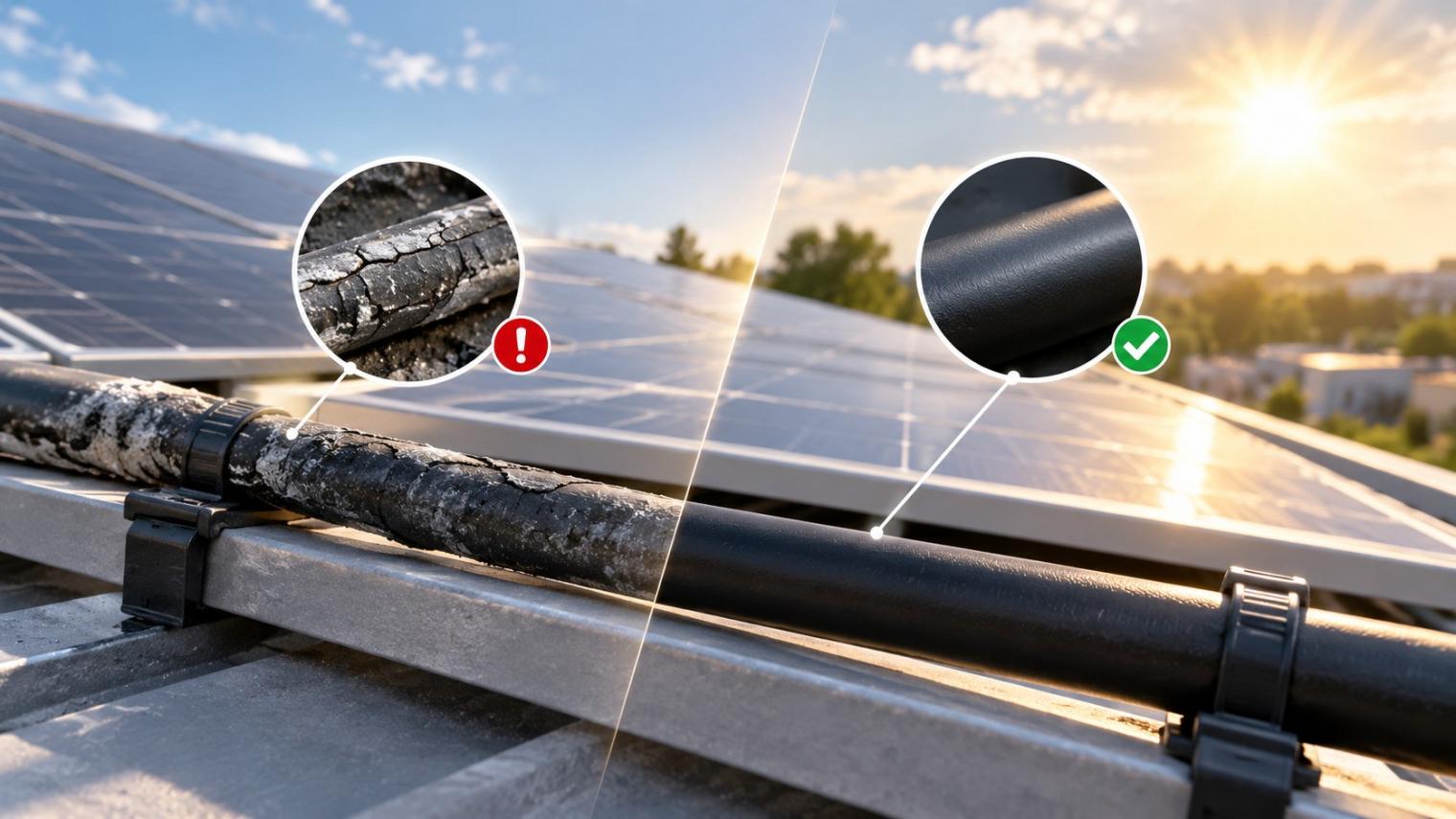
A rooftop solar system has been neatly installed. The panels are clean, the inverter is running, and daily output matches the design forecast. Two or three years later, a technician climbs onto the roof to clean the panels and finds something nobody expected: the cables linking the panels have changed colour, their surface has turned chalky, and when bent slightly, the outer layer shows fine cracks.
The system is still working. Output hasn’t dropped dramatically. But the cable material itself has already lost much of its ability to protect.
This happens fairly often in installations that use ordinary electrical cable for direct current (DC), the type of electricity that solar panels produce. The reasoning makes economic sense: general-purpose wiring cable is much cheaper and easier to find. The problem is that this kind of cable was simply not designed to live under direct sunlight for decades.
This article explains what actually happens to cables exposed to ultraviolet (UV) light, why a rooftop is a far harsher environment than the inside of a wall, and how installers and homeowners can check whether the solar cable they are using is truly fit for the job.
In short, solar cables need to be UV resistant because the cables on the DC side of a solar power system (the part that carries electricity straight from the panels) are permanently installed outdoors, right where they receive the most sunlight, and are expected to last as long as the solar panels themselves. Materials that are not made to handle UV exposure will break down on the surface and lose their flexibility.
But UV resistance is not the only factor. The right choice still needs to take into account the operating temperature, system voltage, conductor size, installation method, and the quality of the cable connections.
A cable’s outer jacket and insulation are made of polymers, which are long chains of molecules that make the material flexible and able to block electricity. Ultraviolet light carries enough energy to break some of the chemical bonds in these chains.
The process happens gradually, in stages you can actually see:
Fading and a chalky surface. This is the earliest stage. The surface loses its shine, the colour fades, and rubbing it leaves a fine, powdery residue. This is a sign that the outermost layer has already started to break down.
Loss of flexibility. Broken polymer chains make the material brittle. A cable that used to bend easily now feels stiff and “crackles” when bent.
Micro-cracks. These appear mainly at bends, at clamps, and in areas that heat up and cool down every day. The cracks are often too fine to see from a metre away.
Water and dirt getting in. The cracks become pathways for rainwater, dust, and salt (especially in coastal areas) to reach the inside of the cable.
This chain of events is what makes UV damage dangerous. Failure doesn’t happen all at once. It builds up quietly over several seasons.
Standard stranded building wire is designed for a conductor temperature of around 70 °C, for low-voltage AC systems (the type of electricity used in household wiring), and for installation in sheltered locations. When it is used as a jumper cable between panels, it is hit by UV, heat, and DC voltage all at once. The risk is not that it catches fire straight away, but that it deteriorates without anyone noticing. What to do: use cable that carries a solar (PV) cable code and meets a solar cable standard along the entire DC route.
Conduit (protective piping for cables) helps protect against physical impact, but PVC conduit that is also exposed to the sun will age and crack as well. On top of that, cables inside closed conduit run hotter because the heat has a hard time escaping. What to do: treat conduit as extra physical protection, not as a substitute for the right cable material.
A cable marked 450/750 V AC is not automatically safe for high-voltage DC strings (rows of panels connected one after another). Insulation handles electrical stress differently under AC and DC. What to do: check that the datasheet clearly states a DC rating, and make sure the system’s maximum voltage stays below it.
The current-carrying capacity, or ampacity, listed in cable tables applies at a specific reference temperature. On a hot roof, and when cables are laid close together, that capacity goes down. What to do: recalculate using correction factors for temperature and for bundled cables, based on the actual load and cable run length.
Using the right cable but pairing it with low-quality connectors, joints wrapped in ordinary tape, or crimping (pressing the connector onto the cable) without the proper tool simply moves the weak point to the connection. Loose connections in a DC circuit are one of the most common causes of electrical arcing (sparks that jump across a gap and can start a fire). What to do: use compatible connectors that meet specifications, along with the proper crimping tool.
For homeowners, any of these four signs is reason enough to call a technician:
Safety warning. The DC side of a solar power system stays live for as long as there is sunlight, even when the circuit breaker (MCB) and inverter have been switched off. Do not open, cut, or repair string cables yourself. If you notice a burning smell, melted insulation, or sparks, keep people away from the area and contact a qualified solar installer or technician. Working on a roof also carries its own separate risk of falling.
Choosing well starts with reading the product, not comparing the price per metre. Check whether the cable code and standard are printed on the outer jacket, whether a technical datasheet is available, and whether the temperature range and DC rating are clearly stated.
Wilson Cables offers H1Z2Z2-K solar cable for the DC side of solar power systems, alongside its range of building wiring cables such as NYM and NYA. Please note that H1Z2Z2-K is a DC cable. The AC side, after the inverter, should still use wiring cable designed for that purpose. Conductor size and cable routing should still be based on load calculations and the installation conditions on site.
You should consult a professional when the system is being expanded, when the DC cable runs are longer than originally planned, when the installation is in a coastal or industrial environment, when the inverter repeatedly shows insulation faults, and when you are taking over a system that someone else installed without documentation.
UV resistance in solar cable is not an extra feature. It is a requirement for the cable to last as long as the system it serves. The wrong cable doesn’t fail on installation day; it fails a few years later, in a spot that rarely gets checked, on a circuit that is never truly switched off.
The most practical steps: make sure the entire DC route uses PV-standard cable, ask for its technical datasheet, recalculate the conductor size based on real site conditions, and schedule regular visual inspections of the cable runs underneath the panels.
Before buying
During installation
Maintenance
Can NYA or NYAF cable be used for solar panels? It is not recommended for DC cable runs that are directly exposed to the elements. These cables are designed for sheltered building installations on AC systems, so they are not tested for long-term exposure to weather and UV, and they have a lower maximum operating temperature.
How long can the right solar cable last? The EN 50618 standard sets an expected service life of at least 25 years under normal use. The actual lifespan still depends on installation quality, the surrounding temperature, and site conditions.
If the cable is run through conduit, does it still need to be UV resistant? Yes. Conduit exposed to the sun ages too, and cables inside closed conduit run hotter. Conduit is best treated as extra physical protection.
How do I know if my solar cable is damaged? Look for noticeable colour change, a chalky surface, cable that has hardened, fine cracks at bends, and repeated insulation fault reports from the inverter. A thorough inspection should be carried out by a qualified technician.
What size solar cable should I use? There is no single answer. The size depends on the string current, the length of the cable run, how much voltage loss is acceptable, the surrounding temperature, the installation method, and how the cables are bundled. The calculation should be based on real installation data.
Is solar cable the same as the cable used on the AC side after the inverter? No. H1Z2Z2-K is intended for the DC side. The AC route after the inverter uses wiring cable that meets the applicable building installation regulations.
Preparing a rooftop solar installation, or reviewing the cables on a system that is already running? Double-check the specifications of your DC cable runs, and use the technical information for Wilson Cables’ H1Z2Z2-K solar cable as a point of comparison. For project needs, the Wilson Cables team can help explain which cable categories are relevant to your installation conditions.
|
Wilson Cables is a trusted electrical cable brand produced by PT. Willson Surya Unggul, a cable manufacture company in Tangerang, Indonesia, which has been established since 1989. Since the beginning, we have been fully committed to producing high quality cables with a choice of products from building cables, automotive cables, audio cables, electronic cables, to cables for use. special.
|
Our Location
Jl. Veteran No.9A, Kadu Jaya, Kec. Curug, Tangerang, Banten 15810
 021-5986868 / 0856-8686868
|
Sitemap
|
Download Our Product Catalog
Download |

|


