
  |

|
 SHOP NOW SHOP NOW |

|
|

|
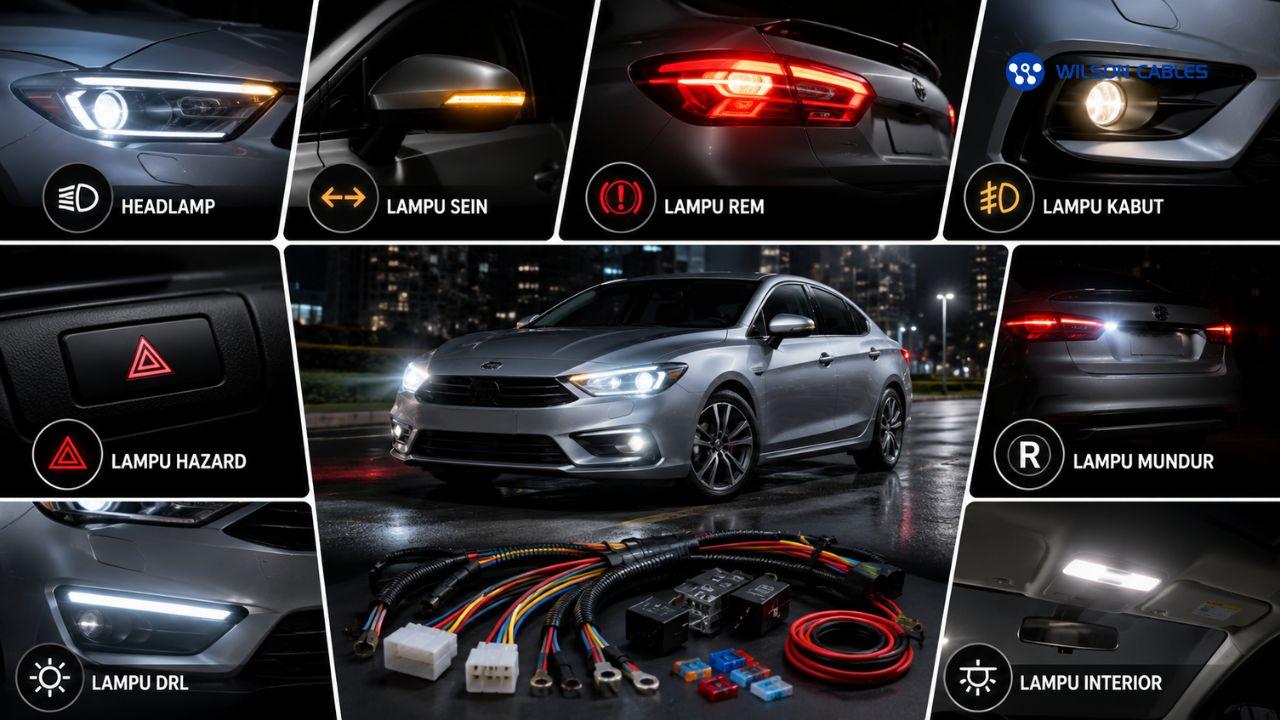
Car lights are one of the most important components of a vehicle’s safety system. In addition to providing illumination while driving at night, car lights also serve as a means of communication between drivers on the road. Each type of light has a different function, ranging from providing illumination and signaling braking to indicating the vehicle’s direction.
Together with advancements in automotive technology, the variety of car lights has expanded significantly, both in terms of function and lighting technology. Here is a comprehensive explanation of the different types of car lights and their functions.
Headlights are the primary lighting source for a vehicle. They are used when driving at night, passing through low-light areas, or in poor weather conditions.
Generally, headlights have two lighting modes: low beam for normal use and high beam for long-distance illumination. Low beam is designed so that the light does not blind other drivers, while high beam is used to provide greater visibility on dark roads.
Currently, many modern cars use lighting technologies such as LED, HID, and BiLED because they produce brighter light and are more energy-efficient than conventional halogen bulbs. In addition to their lighting function, headlights are also an important part of the exterior design of modern cars.
Turn signals are used to indicate the direction a vehicle is about to turn or change lanes. These lights are essential for helping other drivers understand the vehicle’s intended path, thereby reducing the risk of accidents.
Turn signals are typically yellow or orange and are located at the front and rear of the vehicle. In some modern vehicles, turn signals also feature sequential turn signal technology, which causes the lights to illuminate in sequence, giving them a more modern appearance and making them easier for other road users to notice.
Proper use of turn signals is an essential part of driving etiquette because it helps establish safe communication between vehicles on the road.
Brake lights serve to signal vehicles behind that the car is slowing down or stopping. These lights turn on automatically when the brake pedal is pressed.
Since they serve a critical safety function, brake lights must always be in good working order so that other drivers can maintain a safe following distance while driving. If the brake lights are out or dim, the risk of a rear-end collision can increase, especially in heavy traffic or rainy conditions.
Today, many car brake lights use LED technology because they have a faster response time than conventional bulbs, allowing them to provide a more effective braking signal.
Fog lamps are used to improve visibility in foggy, heavy rain, or dusty conditions. They are typically positioned at the bottom of the car’s bumper so that the light can penetrate the fog more effectively.
These lamps are designed with a wider, lower beam pattern to minimize light reflection from the fog. Therefore, fog lamps help drivers see road markings and surrounding conditions more clearly during bad weather.
In addition to improving safety, fog lamps are also often used to enhance a vehicle’s appearance, making it look sportier and more modern.
Hazard lights are the right and left turn signals that illuminate simultaneously. These lights are used as a signal of an emergency, such as when a vehicle breaks down, stops on the shoulder of the road, or experiences a specific problem.
The primary function of hazard lights is to warn other road users to be more cautious of the vehicle’s condition. Proper use of hazard lights can help reduce the risk of accidents, especially in areas with heavy traffic or poor lighting.
However, hazard lights should not be used indiscriminately while the vehicle is in motion, as this can confuse other drivers.
Reverse lights turn on automatically when the vehicle’s transmission is in reverse. These lights help the driver see the area behind the vehicle while signalling to other road users that the car is moving backward.
Generally, reverse lights use white light so that the area behind the car is more clearly visible at night. In modern cars, reverse lights are also often combined with a backup camera and parking sensors to help make manoeuvring the vehicle safer and more convenient.
Reverse lights are especially important when parking in tight spaces or areas with poor lighting.
Daytime Running Lights, or DRLs, are lights that turn on automatically when the car is in use during the day. The primary function of DRLs is to increase the vehicle’s visibility so it is easier for other road users to spot.
Although they do not serve as the primary lighting, DRLs help reduce the risk of accidents because the vehicle becomes more easily recognizable, especially on roads with fluctuating lighting conditions. This technology is now widely used in modern cars because it enhances safety while also enhancing the vehicle’s appearance.
In addition to safety considerations, DRLs also serve as a design element that makes the car look more modern and premium.
All car lights operate through the vehicle’s electrical system. Therefore, the quality of automotive wiring is a critical factor in ensuring that lights perform reliably and safely.
Using cables that do not meet specifications can cause issues such as dim lights, unstable electrical current, and even short circuits. This is particularly important for users who modify their lights—such as upgrading to LED, projector, or BiLED systems—which require optimal electrical supply.
With high-quality cables, electrical current distribution becomes more stable, allowing lights to perform at their best and last longer.
Different types of car lights serve distinct functions to support safety and comfort while driving—such as headlights, turn signals, fog lights, and DRLs—all designed to enhance visibility and communication between vehicles on the road.
In addition to choosing the right type of lights, it’s also important to ensure the vehicle’s electrical system uses high-quality components to maintain optimal lighting performance. Whether you’re into customizing or modifying your car’s lights, Wilson Cables offers high-quality automotive cables to support a safer, more stable, and longer-lasting vehicle electrical system.
|
Wilson Cables is a trusted electrical cable brand produced by PT. Willson Surya Unggul, a cable manufacture company in Tangerang, Indonesia, which has been established since 1989. Since the beginning, we have been fully committed to producing high quality cables with a choice of products from building cables, automotive cables, audio cables, electronic cables, to cables for use. special.
|
Our Location
Jl. Veteran No.9A, Kadu Jaya, Kec. Curug, Tangerang, Banten 15810
 021-5986868 / 0856-8686868
|
Sitemap
|
Download Our Product Catalog
Download |

|


