
  |

|
 SHOP NOW |

|
|

|
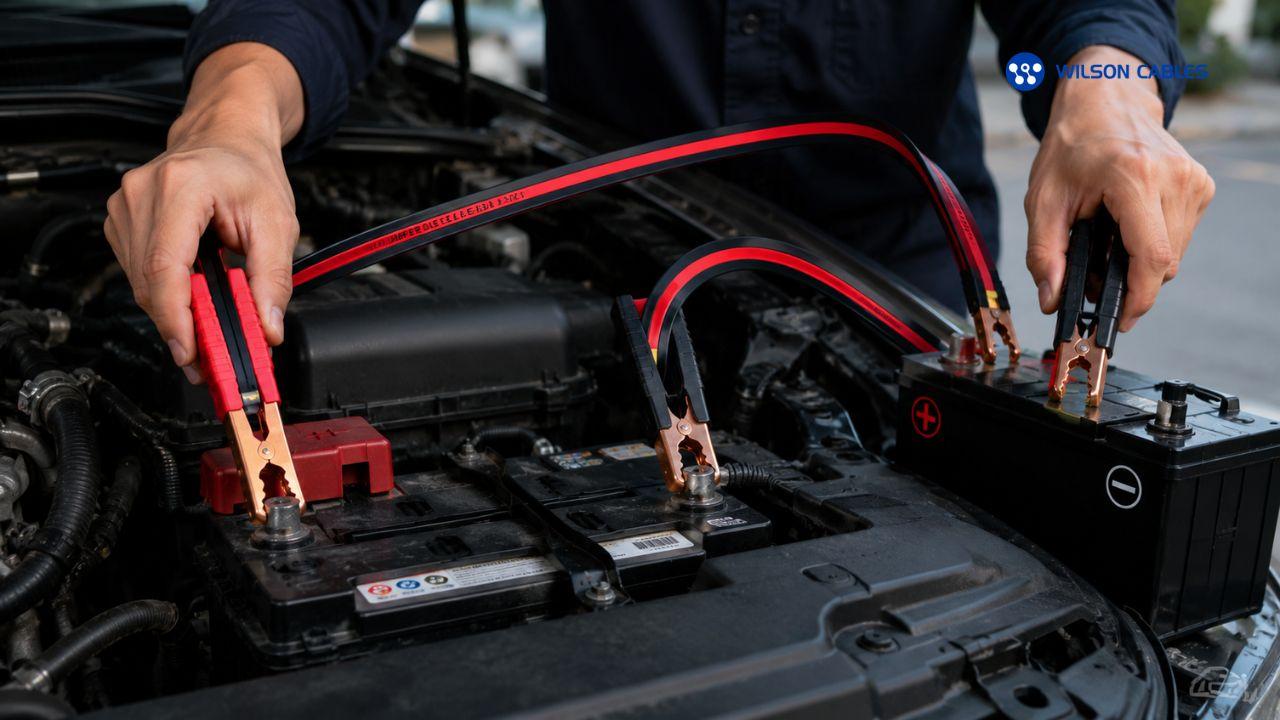
In the automotive industry, one of the most common unplanned emergencies is a weak or worn-out vehicle battery. This situation can occur at anytime and anywhere, whether because of vehicle lights forgotten to be turned off, an aging battery, or certain weather conditions. In this condition, one of the most practical and quickest solutions is to use jumper cables.
However, the success of the jump-starting process depends not only on the condition of the donor vehicle’s battery but is also heavily influenced by the quality of the cable used. Choosing the wrong cable can lead to overheating, voltage drop, and even the risk of damage to the vehicle’s electrical system.
Two common types of cables used for this application are EB (Extra Flexible Battery Cable) and HEB (Heavy Duty Extra Flexible Battery Cable).
Battery jumper cables are electrical conductors used to transfer current from a fully charged battery to a weak or dead battery. This process allows a vehicle that won’t start to receive a temporary power supply.
Technically, when the jumper cables are connected, a high-capacity electrical current flows from the source battery to the dead battery. Since the current flowing is quite high, the cables used must have high conductivity, low resistance, heat resistance, and high flexibility.

The EB cable features fine-stranded copper conductors designed for high flexibility, along with PVC (Polyvinyl Chloride) insulation that is heat-resistant, providing maximum protection for the conductors when carrying a significant current.
EB cables are typically used for jumper cables in personal cars and other light vehicles, which do not have very high current capacities.

HEB cables are the heavy-duty version of EB cables, featuring higher current capacity and greater durability. While sharing similar characteristics with EB cables, HEB cables offer significant advantages over EB cables, both in terms of their thicker insulation—which is more resistant to extreme conditions—and their higher current capacity, which is specifically designed to handle heavier loads and higher currents.
In general, HEB cables can be used for large vehicles, such as buses, trucks, and some heavy machinery.
The standard used for battery jumper cables—specifically the EB and HEB types—is JASO D611:2008. This standard, issued by the Japan Automobile Standards Organization, specifies requirements for Automotive Parts – Unscreened Low Voltage Cables, or automotive cables without electrical shielding for motor vehicles, particularly those used in automotive electrical systems, including battery cables.
This standard specifies the number and diameter of conductors, insulation thickness, as well as the maximum temperature and current that can be applied to the cable based on its size and capacity.
Ensuring quality and safety requires selecting products from trusted manufacturers. One company that offers EB and HEB type cables with guaranteed quality is Wilson Cables, featuring the advantage of 99.9% pure copper conductors, heat-resistant insulation, and RoHS-compliant materials.
After understanding the specifications and standards in use, users can select cables that meet their needs. For optimal results, use high-quality products from trusted manufacturers like Wilson Cables.
|
Wilson Cables is a trusted electrical cable brand produced by PT. Willson Surya Unggul, a cable manufacture company in Tangerang, Indonesia, which has been established since 1989. Since the beginning, we have been fully committed to producing high quality cables with a choice of products from building cables, automotive cables, audio cables, electronic cables, to cables for use. special.
|
Our Location
Jl. Veteran No.9A, Kadu Jaya, Kec. Curug, Tangerang, Banten 15810
 021-5986868 / 0856-8686868
|
Sitemap
|
Download Our Product Catalog
Download |

|


